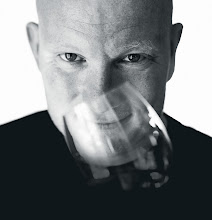
Manfred Krankl

He ws born in Austria, but moved to California in 1980 (and he doesn't sound like Arnold at all!) and later opened up the Le Campanile restaurant in Los Angeles, and the La Brea Bakery company, which he sold for 20 million dollars in 2001.
Wine was always part of his life, but it wasn't until 1992 before he produced his first own wine, the 1992 Black and Blue together with Napa Valley winemaker Michael Havens. There was also a small production of wines for his restaurant Le Campanile. Two years later, in 1994, he established his own label Sine Qua Non. The idea was to produce small batches of great wines out of Syrah and Grenache. The production was, and still is, very limited and after just a few years, Manfred Krankl and his Sine Qua Non wines had become well known among wine collectors.
"I didn't have any formal education in growing vines or making wine, I learned it by trying, and now I'm too old for it anyway", he says.
He is one of the most detailed oriented wine makers of California, hence the perfection in his wines, that are huge and packed with super ripe and strictly sorted grapes. Even though he didn't had any vineyards on his own until he planted the now 8.90 hectare Eleven Confession Vineyard in the southern part of the cool Santa Rita Hills, he have always spent a lot of time in the vineyards.
He was lucky already in his first vintage (1994, unfortunately not tasted here) by being able to purchase grapes from famous vineyards like Alban Vineyard, Bien Nacido Vineyard and Stolpman Vineyard. Over the years, new great vineyard sites has been added to the program, like the great Whitehawk Vineyard in Los Alamos. Manfred did always farm the same blocks in each vineyard, hence the even quality over the vintages. 
In 2004 he planted various grape varieties, mostly Syrah and Grenache, but also Petite Sirah, Touriga Nacional, Mourvèdre, Roussanne and Petit Manseng in his beautiful estate in Oak View in the much warmer Ventura County. Today there are three blocks and a total of 12.3 hectares in this Cumulus Vineyard, plus the brand new state of the art winery he moved into for the 2011 harvest.
"Although much bigger and much better planned and easy to work in, it felt a bit unusual and strange after all the years in my old garage winery in Ventura", Manfred says.
Another vineyard, the now called The Third Twin Vineyard, was added to his estate program in 2010, a total of 6.10 hectares of Syrah and Grenache in Los Alamos close to Whitehawk Vineyard and Stolpman Vineyard just north of Santa Rita Hills. The ranch covers 120 hectares, and according to Manfred, there are several slopes to be planted in the future. With this, he may be one hundred percent estate grown within a few years from now. As of 2011, the only grapes he purchase is the ones from Bien Nacido Vineyard in Santa Maria Valley.

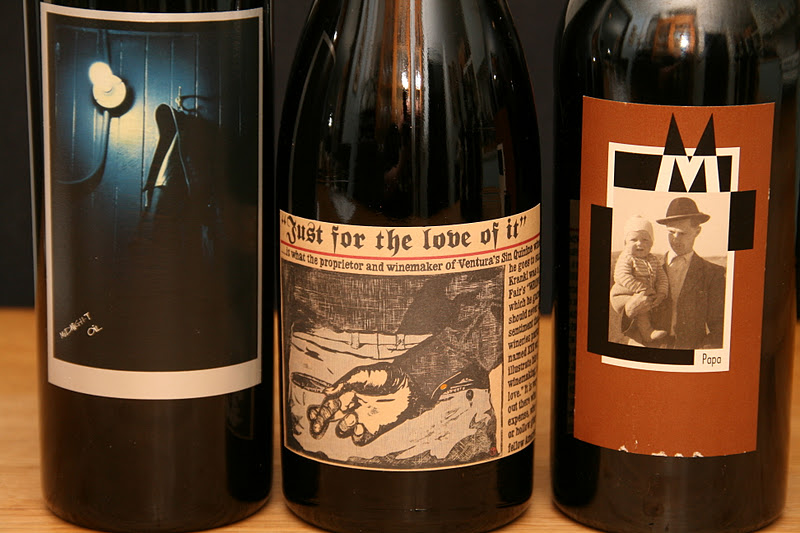
Another hype around Sine Qua Non is of course the names and labels of the wines. Each wine carries a unique name ("Why give all your children the same name?", Manfred ask you when you ask him about this), and an artistic label, made by Manfred himself. This have not only created a sort of collecting phenomenon, but also inspired other wine producers to do the same. The difference is that Manfred Krankl is a true artist, in that sense Sine Qua Non is one of the most unique wineries of this planet!
The style of his Syrah and Grenache wines is ripe, typical Californian in most ways, yet one may mistake his wines for being the exclusive "La-La's" of Guigal (particularly La Landonne or the more lush La Mouline in warmer vintages). The Sine Qua Non wines are not for those who seeks light bodied wines with high acidity and more terroir than fruit and body.
The wines are crafted from highly ripe grapes, they are mostly destemmed (sometimes by hand) but certain lots are whole cluster fermented in small open top fermenters with manual pigage, or in small cement eggs. Maceration is long, and the ageing takes place in mostly French oak barrels (225 and 500 liters), of which a great proportion are new. Ageing stretches over 18-22 months, until the wines are ready to blend and bottle.
I have been fortunate to follow the Sine Qua Non wines for more than a decade, I taste them regularly and I have also visited Sine Qua Non and tasted with Manfred a numerous of times. By all means, he is one of the most careful, detailed oriented and uncompromising winemakers in California. Therefore I'm proud and happy to appoint Manfred Krankl as the Winemaker of the Year 2011.
Vertical of Syrah from Sine-Qua-Non 2008-1995
(all wines tasted in one vertical tasting in 2011) 2008 B-20 / 95-96 p
”This was the first of four consecutive vintages, and we didn’t harvest until November 24”, Manfred says. The extra long hang time resulted in a high phenol ripeness, but not overly high sugars, therefore Manfred was vary happy about this harvest. ”However, it will take some years before it start to show it true potential”, he adds.
Like all young wines from Sine Qua Non, this is compact and full of flavors, and even though there’s abundant of richness of blackberries, blueberries, dark cherries and even toffee, there’s something quite elegant over the nose. It’s not as impressive as some other vintages shown at this stage, but it’s rather av kind fresh elegance to it. Plus, I must say, some sweet and slightly spicy oak notes. On the palate it’s full bodied and rich, initially with some warmth from the alcohol, but giving it half an hour in a decanter, a more elegant structure reveals, and then the alcohol seems to soften a bit. Again, it’s not a powerful wine in that sense warmer and riper vintages are, still there’s a serious structure of tannins to balance the ripe fruit and make the finish totally dry. There’s a fine silky texture and a long finish, but also a youthful wildness that lead me to the conclusion that this wine needs several years in the bottle before it reach its very best balance and drinkability. And patience is always rewarding when it comes to the wines from Sine Qua Non.
Drink it over the next 5-18 years

2007 Labels / 96-97 p
In this vintage, the blend was made up by 89 percent Syrah, seven percent Grenache and the rest Viognier. Grapes were predominately harvested in the two estate vineyards Eleven Confession in Santa Rita Hills and Cumulus Vineyard in Ventura County, but 17 percent of all Syrah came from Bien Nacido Vineyard in Santa Maria Valley, en the same amount from the great Whitehawk Vineyard in Los Alamos. The wine spent 22 months in French oak barrels, of which 65 percent were new. The alcohol level is 15.3 percent. ”I really like the 2006 vintage, my wines are rich without being exuberant or too concentrated”, Manfred says.
If 2006 Raven was a bit difficult to judge at this young stage, the 2007 Labels is in the same position. They are also quite similar, with a mind blowing richness with abundant of perfectly ripe fruit flavors, yet so restrained and structured. It sounds like a contradiction, but that’s the way these wines are. The nose offers super ripe blueberries, almost like the finest confiture as well as crème de cassis, and it’s mostly about all those charming primary aromas.
With some aeration, some complexity showed, but it took almost 5-6 hours in the decanter before the wine really opened up and showed white pepper, violets and some sweet and spicy notes from the barrels. On the palate it’s ripe, voluptuous, there’s a slight bitterness from the oak and perhaps also from the stems, but it’s almost totally covered up by the richness. Overall it’s an impressive wine that’s far too young to even taste today. I’ll keep my bottles at least three to four more years before I touch them – Labels is a wine for the future.
Drink it over the next 5-20 years
2006 Raven / 97 p
The Raven is made of 93 percent Syrah, five percent Grenache and just two percent Viognier, most of the grapes from the estste vineyard Eleven Confession in Santa Rita Hills. The wine spent 21 months in almost all new French oak barrels, but some of them were larger, 600 liters. This very good vintage, the alcohol reached 15.3 percent. From a stylistic point of view, Manfred think of 2006 Raven as something inbetween 2002 Papa and 2004 Poker Face, without being as concentrated as the latter.
It’s always hard to find the most elegant nuances in a young powerful wine like Raven, but already in at just one sniff, the greatness in it reveals. And that’s what I very often find in the wines from Sine Qua Non, an unlike most winemakers, Manfred has the talent to craft huge wines and blend them in a way where the richeness and concentration doesn’t end up in overwhelming wines. He is the master in maximizing power and new expensive oak barrels and still stay in balance.
Again aeration is nessicary for this young wine, and then a very fine note of white pepper and ink as well as a slight vegetal fragrance (from the stems) and notes of violts and aloe vera rises throught the compact fruit. On the palate, it's full bodied with an almost viscous texture, packed with ripe fruit and still so rich in its primary fruit flavors that I recommend a few more years of bottle age before it's opened. The tannins are important but well in balance, therefore almost silky. Complexity is not in my tasting notes of today, but I guess it will come in the coming years.
Drink it over the next 5-20 years
2005 Atlantis 1 Fe2O3 / 97-98 p
In this vintage, the blend was made of 93 percent Syrah (around 40 percent from Eleven Confession, almost 30 percent from Whitehawk Vineyard, some 20 percent from Alban Vineyard in Edna Valley, and the rest from Bien Nacido Vineyard), five percent Grenache from Eleven Confession and just two percent Viognier. Around 25 percent of the clusters were kept whole under the fermentation, and the maceration stretched over 17 days. Two thirds new French oak were used, the rest was used French but also a few American oak barrels. The ageing lasted for 22 months. Alcohol level reached 15.7 percent. This was the first vintage Manfred decided to use three different labels for his wines. ”It is great fun to see how surprised people are when they unwrap the paper the bottles are wrapped in”, he says and laughs.
Although this wine is just a baby, one can clearly see the greatness in it. It’s packed with ripe, slightly sweetish and dense dark fruit flavors (cherries, blueberries and cassis), but there’s also cooler scents of crushed white pepper as well as a spicy touch of the stems, and a touch of new oak. The concentration is obvious, but even though the aromas and flavors are so intense, the wine is actually quite closed. This is more obvious when decanting the wine and one realize that it takes more than 5 hours in the decanter before it really starts to open up.
Man, this wine is really impressive, and its glycerol and silky fruitiness covers the huge but perfectly ripe tannic structure, hence giving the wine an almost velvety texture. At this youthful stage, there’s also a slight spiciness and bitterness from the stems, but that’s just fine.
Overall, there’s so much energy in the wine and taste seems to linger for minutes. As in so many wines from Sine Qua Non, it’s so impressive and good to drink already now. Knowing these wines from several tastings and vertical tastings like this one, I know that the real greatness will show with some more bottle age. The foresight for the most complex taste stretches at least 10-15 years from now. It may well be one of the classic vintages from Sine Qua Non.
Drink it over the next 5-18 years
2004 Poker Face / 98-99 p
In this warm vintage, 96 percent of the blend was Syrah, a third of that from the cooler Eleven Confession Vineyard in Santa Rita Hills and the rest from Whitehawk Vineyard, Bien Nacido Vineyard and Alban Vineyard. The 2.5 percent of Mourvèdre that added spiciness in the blend was sourced from Alta Mesa Vineyard, and the rest is 1.5 percent of Viognier. As always, all varieties and all vineyard blocks were vinified and kept separately throughout the 27 months of ageing in almost 90 percent new French oak (this vintage, 17 barrels made the cut into Poker Face). Alcohol level is 15.5 percent. As the other young wines, this is almost opaque, unredeemed and massive fruit in a style which, oddly enough, also offers great elegance. Perhaps it is the small nuances of violets that makes the dark sweet cherry fruit so easygoing and, which I like so much, moves the focus from the youthful vanilla and smoky scents from the oak barrels. The nose is really remarkable.
The flavor is as concentrated of seductive cherry, sloe and raspberry fruit with the same elegant fragrance of violets and licorice, and both tannins and acidity gives the wine a serious backbone that promises a slowly evolving life that probably extends until 2025, at the very least. However, already today the superlatives are many, especially the remarkable balance between sheer power and seductive flavors, but with time more complexity will rise out of the dense primary fruit. The fresh acidity, which is so well integrated and balanced in the rich fruit, should not be underestimated - it will help giving the wine a long life. Poker Face is a great wine!
Drink it over the next 5-20 years
2003 Papa / 96 p
This lovely wine is made of 97 percent Syrah, two percent Mourvèdre and one percent Grenache. Grapes were sourced from Whitehawk Vineyard, Bien Nacido Vineyard, Alban Vineyard, the warmer Shadow Canyon Vineyard in San Luis Obispo County and Alta Mesa Vineyard, and for the first time also from the (now) 8.90 hectare estate vineyard Eleven Confession, planted in 2001 on a plateau above Arita Hills Vineyard (owned by Lafond Winery) in the southern part of Santa Rita Hills. The wine was matured in 90 percent new French oak barrels for 27 months, and as all wines from Sine Qua Non it was bottles without fining or filtration. ”I named this wine in honor of Matias Krankl, my dad, a very ordinary man who grew up in Czech Republic under poor circumstances – he left school after six years to work hard as an apprentice at a shoemaker, thereafter he worked even harder in the coal mines before he got a much safer job as a driver”, Manfred tells. ”Then he married a young and fantastic woman, and 22 years old, he became my father”, he adds.
Dense, youthfully purple and almost opaque, and almost equally massive in its aromas. When you try through the vintages from Sine Qua Non, you realize that Manfred Krankl is masterful in balancing the oak flavors, but in the younger vintages some sweetness, vanilla, slightly roasted and spicy oak flavors will be noted in the sweet and dense fruit. The concentration is huge with loads of ripe and lush fruit, and perfectly pure, in young vintages typically dark cherries, blueberries and blackberries as well as a dash of wild raspberries and a deliciously spicy violet note. Although the taste is so concentrated, full of ripe fruit, alcohol and glycerol to a very silky texture, there is enough of acidity, minerals and tannins to give the taste a great energy. It is not nearly mature and at its peak, not even five hours of decanting is enough to open up all the flavors. Two to three years of maturing would help.
Drink it over the next 2-18 years
2002 Just For The Love Of It / 99-100 p
This is one the best syrahs ever from Sine Qua Non, including the longer aged versions. It was made of 96 percent Syrah and two percent each of Grenache and Viognier. All grapes were sourced from Alban Vineyard in Edna Valley, Bien Nacido Vineyard in Santa Maria Valley, Stolpman Vineyard and White Hawk Vineyard in Santa Ynez Valley and just a little from Shadow Canyon Vineyard in San Luis Obispo County. Around 90 percent of the barrels were brand new, and all French. Alcohol level is 15.2 percent. The name symbolizes the true passion and love for wine that so many – but not all – people show. ”The ones who live their lives from the heart”, Manfred says.
It has always been something special about this wine. When I tried a number of components from barrels at Sine Qua Non in 2003, I realized that Manfred Krankl with this vintage had placed himself on a level among the world's biggest stars. All barrel samples we tasted was outstanding, but Manfred said they lacked that greatness he looks for, and that he achieves by blending different grape varieties, batches of different vinification and from various vineyards. I thought of it then, by tasting several great components, as the finest wine made in the modest shed in downtown Ventura.
The wine is young, still purple, deep and intense, and the nose is rich with a deliciously sweet yet tangy and fresh note of cherries, wild raspberries and strawberries, it is so rich, fruity and deep, as well as earthy and complex, that it almost resembles an astounding cuvée of the best parcelles in Chambertin Grand Cru, added the finest flavor that can come from a pure wine of Grenache. The taste is rich and almost explosive, yet so elegant and vivid in its fruit saturated and tangy style. The oak is perfectly well balanced. Again, I'm impressed by the magnificent balance between pure power and elegance that Manfred is so skilled in capturing.
There is really only one reason not to drink this wine today, and that is that it actually has the potential to evolve for many more years to come.
Drink it over the next 10-15 years
2001 Midnight Oil / 97-98 p
A blend of 96 percent Syrah, 2.5 percent Grenache and 1.5 percent Viognier from Bien Nacido Vineyard, Stolpman Vineyard, Alban Vineyard and Whitehawk Vineyard. Vinification is the same as for the other vintages with around 90 percent of the barrens new. Alcohol level this great vintage didn’t jump over 15 percent, it was ”just” 14.9 percent. The production this year was 950 cases of six bottles. Ten years old, still young and totally vital! The aroma is open and intense, well stuffed with sun ripe dark berries, blueberries and plums, but also with a really nice touch of lavender and licorice. Compared to the older vintages, one may find traces of the oak barrels in which the wine was brought up, but not more than a shadow of vanilla and grilled bacon (that note disappears after half an hour in the decanter, and instead all focus is set on the magnificent fruit). The flavor is equally intense and deliciously fruity, still quite marked by its tannins and good acidity, which gives a vibrant energy. This oil is one of the finest lubricants Manfred Krankl has given his wine quenching crowd of supporters. Despite the youth, it's absolutely good to drink now, but with a few more years of ageing the balance will be a little more polished, and life from that date extends at least 15 years.
Drink it over the next 15 years

2000 In Flagrante / 96-98 p
In this millennium vintage the Syrah fraction was the lowest of Sine Qua Non wines ever, it was only 88 percent. The rest was ten percent Grenache and two percent Viognier. Grapes came from Alban Vineyard, Bien Nacido Vineyard, Whitehawk Vineyard and Stolpman Vineyard in Santa Ynez Valley. The juice was fermented in stainless steel tanks and was then transferred into French barrels, only 72 percent new, for malolactic fermentation and 19 months of ageing. Again alcohol level stopped at 14.9 percent. A total of 725 cases of six were made of In Flagrante. Deep, dark purple and still young, but with some deposit which reveals the wine wasn't filtered before bottling. The nose is dense, exuberant and massive with both cool scented and sun ripe and sweet fruit flavors, added with notes of liquorices and lavender, and even if the wine is young and so concentrated, there is also a more earthy hue that adds complexity. The body is still rich with somehow viscous fruit, glycerol and alcohol sweetness, and it took almost two hours of decanting before the aromas and flavors met each other in perfect harmony.
The wine is still young and unredeemed, but with aeration it opened up to a greater complexity with notes of air dried meet, charcuteries and white pepper, yet with the fruit in dominance. If absolute power and stylish elegance manage to find each other, they tend end up in a wine of this caliber. A few hours of aeration in a decanter is recommended, but rather should wine be mature in the bottle for a more few years.
Drink it over the next 10 years
1999 The Marauder / 97 p
One hundred percent Syrah, that’s the deal for the Marauder, and this is the only single Syrah wine made here at Sine Qua Non, ever. Around 40 percent of the grapes came from Alban Vineyard, 36 percent from Bien Nacido Vineyard and 24 percent from Stolpman Vineyard. Fermentation took place in stainless steel tanks and the wine was then transferred into brand new French oak barrels for malolactic fermentation and 17 months of ageing on its lees. ”My racking regime is all depending on each barrel, some barrels will remain unracked, some will be racked one time, others two or even three times”, Manfred says. Alcohol level is 14.9 percent. Only 1 998 bottles was made!At first this was wine was a bit shy, although the dark and still slightly youthful purple color gives the impression that the wine still should be considered to be a young wine (except the fine sediment that revealed some bottle age). The nose is just lovely, after just some aeration absolutely delicious with both primary fruit aromas (sweet black currants, cherries and sun ripe blackberries) and more complex earthy, spicy and floral (violets) notes. To this, a fine acidity and a good grip of firm but ripe and to a certain extent also matured tannins are added.
Like so many 1999s, this wine shows that the vintage wine is superb and still not yet near to step into full maturity. One or two addition years in the cellar is a good thing, primarily to polish the tannins a bit more, and it will keep well until shortly after its twentieth anniversary.
Drink it over the next 10 years
1998 E-raised / 96-97 p
In this vintage, the cuvée was made of approximately 95 percent Syrah, five percent of Grenache and just a splash of Viognier. The grapes came from Alban Vineyard, Bien Nacido Vineyard and Stolpman Vineyard. The wine was aged in all new French oak barrels for around 20 months, and it was bottled without fining or filtration. In this cooler El Niño vintage, alcohol only reached 14.0 percent. E? Well, that’s Elaine, Manfred’s charming wife. ”Without whom Sine Qua Non wouldn’t have been flying”, Manfred says.
Thanks to the cool growing season of 1998, this wine has a lively acidity that creates a beautiful and life giving structure. The fruit is brighter, still raspberry like and floral, and in fact almost unrelieved which gives the wine a great elegance, and makes it a little different than most vintages in the lineup. A delicious spicy note of fennel and liquorices root adds complexity. Due to the lighter body, some alcohol warmth is noted, but overall the wine is very elegant and lively. As in all vintages with just some age, the feeling of oak almost non-existent, and with aeration the red fruit flavors was lifted. In the aftertaste it offers an even sweeter, more lush and refined flavor of wild raspberries. Purely in terms of aromas, the E-raised could be seen as a hybrid between high quality burgundies and stylish wine of Grenache from southern France. The 1998 vintage is generally described as weak, or even bad for red wines in California, but in this particular case the wine has developed into a elegant, aromatic and well structured wine!
Drink it over the next 6-8 years

1997 Imposter McCoy / 93 p
Again, Alban Vineyard, Bien Nacido Vineyard and Stolpman Vineyard were the source of the 95 percent of Syrah and five percent of Grenache that made up this vintage. Yields was very small this vintage, and the production was around 2 900 bottles. Alcohol level is 14.9 percent. This vintage is usually hailed as excellent and even phenomenal in Napa Valley and Sonoma, but down in Santa Barbara 1997 was one of the most difficult vintages in living memory. As in northern California it was hot, and the yields was unusually large, resulting in wines that are both a bit lighter and more fast maturing. This is evident in this wine, which certainly starts great with fine primary fruit aromas, and it even opened up a bit in the glass with some air, however it started to fade a little after a while - and even if the wine landed at a level that in other contexts might be described as really good, 1997 is one of the few weaker cards in the line up from Sine Qua Non. The fruit is a bit sweet, reminiscent of cherry liqueur with notes of blueberries and blackberries, much like a wine from Priorat in Spain, but with air it starts to dry out and thus that roughness becomes somewhat more austere than the other wines. Yet there has enough interesting flavors to the wine to be really good. There are similarities with the great wines of Châteauneuf-du-Pape, which has reached a kind of lap time in their lives. Drink now and until 2015, or something like that.
Drink it over the next 8 years
1996 Against The Wall / 97 p
”This was a very tuff year for us, we really felt we were pushed against the wall, hence the name of this wine”, Manfred says. It is a blend of 92 percent Syrah from Alban Vineyard, Bien Nacido Vineyard and Stolpman Vineyard, and eight percent Grenache from Stolpman Vineyard. After fermentation, as always with the indigenous yeast, the wine was racked into new French and (some) American oak barrels for malolactic fermentation and ageing for 19 months. Alcohol level is 14.5 percent. The production this year was 3 576 bottles. The color reveals a slight nuance of maturity, still it is quite dense and yet with a deep, almost purple core. The nose is equally intense, developed in a way that many wine tasters usually describe as Bordeaux like, but there is still a sufficient power and youthful intensity in the fruit, which is both dark and a bit primary sweetish. This leads to the conclusion that this vintage has more to offer in the coming years. Nuances of fennel and licorice adds some complexity. Tannins are vital but mature and almost silky, thanks to the quite rich and slightly sweet fruit flavors and lively acidity, the aftertaste lingers for a minute or so, contributing to finesse. This is an extremely elegant wine which initially felt almost grenache like in its seductive fruit flavors, but with aeration it develops into a greater finesse. Although a very good wine indeed, I don't believe it will evolve into something much more complex with further ageing.
Drink it over the next 4-5 years
1995 The Other Hand / 94 p
During the 90s, a lot of things changed in California. One thing was the transition from more classic styled wines into riper and fuller bodied wines with higher alcohol. Therefore, I’m not surprised to see that the 1995 vintage from Sine Qua Non only have 13.5 percent alcohol. The blend this year, the second vintage for Sine Qua Non, was 94 percent Syrah and six percent Grenache from Alban Vineyard, Bien Nacido Vineyard and Stolpman Vineyard. The wine was aged in 70 percent new barrels, alls French, for 18 months. A total of 2 100 bottles was made and they was sold in cases of five with one bottle of the grenache. The color still shows small traces of purple, almost as if the wine is young. The nose is great, intense rather than powerful and still fruit driven with notes of both sweeter dark berries and aromatic red fruits. With some air a more mature side starts to show, with complex secondary and earthy aromas of sous bois, cedar tree and tobacco. An almost fennel like spiciness and a floral nuance is still there to create excitement. The taste is medium full with dark fruit flavors and notes of violets, the tannins are ripe but still adds some resistance in the rich and slightly viscous mouth feeling, but giving the wine more aeration the age starts to show in the aftertaste, which now begins to show some signs of drying out. I'd love to find another bottle so drink again, then just decanted prior to serving it, just because it is so complex.
Drink it over the next 4-5 years